


A Breast Cancer Diagnosis Brings Many Questions
"Doctor, will I lose my breast?"
This is one of the first and most emotional questions many women ask after learning they have breast cancer. For most patients, the diagnosis itself is frightening, but the possibility of losing a breast often adds another layer of anxiety. Concerns about body image, family life, recovery, and the future begin to surface immediately.
The reassuring news is that a breast cancer diagnosis does not automatically mean that the entire breast needs to be removed.
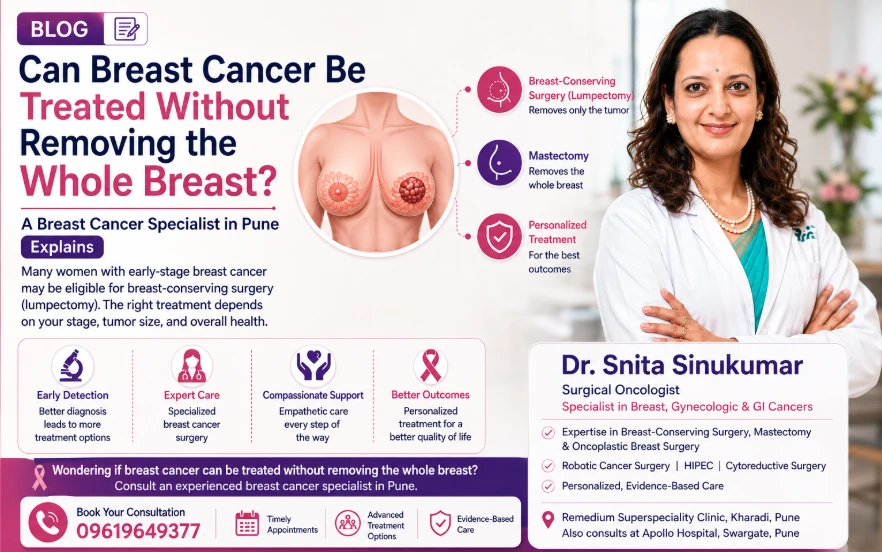
Over the past few decades, advances in breast cancer surgery have transformed the way many women are treated. Today, many patients with early-stage breast cancer can safely undergo breast-conserving surgery, also known as a lumpectomy, where only the cancerous tumour and a small margin of surrounding healthy tissue are removed while preserving the rest of the breast.
However, breast-conserving surgery is not the right option for every patient. The most appropriate treatment depends on several medical factors, including the size and location of the tumour, the stage of the cancer, imaging findings, lymph node involvement, genetic risk, and your overall health.
As a breast cancer specialist in Pune, Dr. Snita Sinukumar believes that every woman deserves a personalised treatment plan based on the latest evidence and her individual needs. Treatment decisions should never follow a one-size-fits-all approach. Instead, they should balance effective cancer treatment with quality of life, cosmetic outcomes, and long-term recovery.
In this guide, you'll learn:
- Whether breast-conserving surgery is possible
- When mastectomy is recommended
- How surgeons decide between different treatment options
- What to expect before and after surgery
- Common myths about breast cancer surgery
- Questions you should ask during your consultation
By understanding your options, you can approach your treatment with greater confidence and make informed decisions together with your healthcare team.
Understanding Breast Cancer
Before discussing treatment options, it's important to understand what breast cancer actually is.
Breast cancer develops when cells within the breast begin to grow in an uncontrolled way. Instead of behaving like healthy cells, these abnormal cells multiply, forming a tumour. If left untreated, some breast cancers can invade nearby tissues or spread to other parts of the body.
Breast cancer is the most commonly diagnosed cancer among women worldwide, but advances in screening, diagnosis, surgery, and systemic therapies have significantly improved outcomes. When detected early, many breast cancers are highly treatable, and survival rates are excellent.
One of the biggest reasons treatment has improved is that breast cancer is no longer viewed as a single disease. Different types of breast cancer behave differently, which is why treatment is tailored to each patient.
Types of Breast Cancer
Some of the more common types include:
- Ductal Carcinoma in Situ (DCIS): An early, non-invasive cancer confined to the milk ducts.
- Invasive Ductal Carcinoma (IDC): The most common form of breast cancer, accounting for the majority of cases.
- Invasive Lobular Carcinoma (ILC): Begins in the milk-producing glands and can be more difficult to detect on imaging.
- Inflammatory Breast Cancer: A rare but aggressive type that requires specialised treatment.
- Triple-Negative Breast Cancer: A subtype that often requires a different treatment approach because it lacks certain hormone receptors.
- HER2-Positive Breast Cancer: Characterised by overexpression of the HER2 protein and often treated with targeted therapies in addition to surgery.
Each type of breast cancer has its own biological characteristics, and these influence the recommended treatment plan.
Does Every Woman with Breast Cancer Need a Mastectomy?
No.
One of the biggest misconceptions about breast cancer is that the entire breast must always be removed. This was a common approach decades ago, but modern breast cancer treatment has evolved considerably.
For many women diagnosed with early-stage breast cancer, breast-conserving surgery followed by radiation therapy offers outcomes comparable to mastectomy in terms of long-term survival, provided the patient is an appropriate candidate.
The goal of surgery is not simply to remove as much tissue as possible. Instead, it is to remove all of the cancer while preserving healthy tissue whenever it is medically safe to do so.
This shift towards personalised care has allowed many women to retain the natural appearance of their breast without compromising cancer control.
That said, breast conservation is not suitable for every patient. The decision depends on careful evaluation by a cancer specialist in Pune experienced in breast cancer surgery.
What Is Breast-Conserving Surgery?
Breast-conserving surgery, also called a lumpectomy or wide local excision, involves removing:
- The cancerous tumour.
- A small rim of healthy tissue around it (called the surgical margin).
- Sometimes nearby lymph nodes for staging, depending on the case.
Unlike a mastectomy, the majority of the breast remains intact.
For many women, this approach offers several advantages:
- Preserves the breast's appearance.
- Can reduce the emotional impact associated with breast removal.
- Provides cancer control comparable to mastectomy in appropriately selected patients.
- Often allows a quicker physical recovery.
Most patients who undergo breast-conserving surgery will also receive radiation therapy afterwards to reduce the risk of local recurrence. Your healthcare team will explain whether radiation is recommended in your specific case.
When Can the Breast Be Preserved?
Whether breast-conserving surgery is possible depends on several factors. Rather than focusing on a single criterion, surgeons consider the overall clinical picture.
1. Tumour Size Relative to Breast Size
The size of the tumour alone is not the only consideration. A small tumour in a small breast may require a different approach than the same-sized tumour in a larger breast. The aim is to remove the cancer completely while maintaining a satisfactory cosmetic result.
2. Location of the Tumour
The position of the tumour within the breast influences the surgical plan. Tumours near the nipple or involving a large area of the breast may require different techniques compared with tumours located towards the outer portion of the breast.
3. Number of Tumours
Breast-conserving surgery is generally more suitable when there is a single tumour. If cancer is present in multiple areas of the breast, a mastectomy may provide better disease control.
4. Surgical Margins
Your surgeon must be able to remove the tumour with a surrounding margin of healthy tissue. If clear margins cannot be achieved while preserving the breast, additional surgery or mastectomy may be recommended.
5. Radiation Therapy
Breast-conserving surgery is usually followed by radiation therapy. If radiation is not appropriate because of certain medical conditions or previous treatment, a mastectomy may be a more suitable option.
6. Patient Preferences
Medical suitability is only one part of the decision. Some women strongly prefer breast preservation whenever possible, while others may feel more comfortable choosing a mastectomy after discussing the risks, benefits, and expected outcomes with their surgeon.
Shared decision-making ensures that the final treatment plan aligns with both the medical evidence and the patient's personal values.
Patients Also Ask
1. Does breast cancer always require removal of the entire breast?
No. Many women diagnosed with early-stage breast cancer may be candidates for breast-conserving surgery (lumpectomy), where only the tumour and a small margin of surrounding healthy tissue are removed. The most suitable treatment depends on the stage, size, location of the tumour, imaging findings, and your overall health. Your breast cancer specialist will recommend the approach that provides the best balance between effective cancer treatment and preserving your quality of life.
2. Can breast cancer be cured without removing the whole breast?
For many women with early-stage breast cancer, breast-conserving surgery followed by radiation therapy has been shown to provide long-term outcomes comparable to mastectomy when patients are appropriately selected. However, not every patient is eligible for breast conservation, so treatment decisions should always be individualised.
3. How do doctors decide whether I need a lumpectomy or a mastectomy?
Several factors are considered, including:
- The size of the tumour
- The location of the tumour within the breast
- Whether there is one tumour or multiple tumours
- Breast size
- Biopsy results
- Imaging findings
- Whether radiation therapy is appropriate
- Your overall health and personal preferences
Your surgeon will discuss all available options before recommending a treatment plan.
4. Is breast-conserving surgery as safe as mastectomy?
For many women with early-stage breast cancer, breast-conserving surgery followed by radiation therapy provides survival outcomes comparable to mastectomy. The key is careful patient selection and complete removal of the cancer with clear surgical margins.
5. Does preserving the breast increase the risk of cancer coming back?
Not necessarily. When breast-conserving surgery is combined with recommended treatments such as radiation therapy and regular follow-up, many women achieve excellent long-term outcomes. Your surgeon will discuss your individual risk based on your diagnosis and pathology.
6. Is every breast lump cancer?
No. Many breast lumps are non-cancerous (benign), such as cysts or fibroadenomas. However, any new breast lump, persistent swelling, nipple changes, or unusual breast symptoms should be evaluated promptly by a qualified doctor.
7. When should I consult a breast cancer specialist in Pune?
You should consider consulting a breast cancer specialist if you notice:
- A new breast lump
- Changes in breast size or shape
- Nipple discharge, especially if blood-stained
- Skin dimpling or puckering
- Persistent breast pain associated with a lump
- A lump in the armpit
- An abnormal mammogram or biopsy result
Early evaluation often leads to earlier diagnosis and more treatment options.
8. Why is it important to consult a surgical oncologist instead of delaying treatment?
Early consultation helps confirm the diagnosis, determine the stage of the disease, and identify the most appropriate treatment. Delaying medical evaluation may reduce treatment options in some cases. Seeking timely advice from an experienced breast cancer specialist allows treatment to begin at the most appropriate stage.
9. Can I get a second opinion before deciding on breast cancer surgery?
Yes. Seeking a second opinion is common and can help you better understand your diagnosis, treatment options, and the benefits and risks of different surgical approaches. Many patients find that a second opinion gives them greater confidence in their treatment decisions.
10. What questions should I ask during my first consultation?
Some useful questions include:
- What type of breast cancer do I have?
- What stage is my cancer?
- Am I eligible for breast-conserving surgery?
- Why are you recommending this treatment?
- Will I need chemotherapy or radiation therapy?
- What is the expected recovery time?
- What are the possible risks or complications?
- How often will I need follow-up appointments?
- Should I consider breast reconstruction?
- Is a second opinion recommended in my situation?
Preparing these questions in advance can help you make the most of your consultation and better understand your treatment options.